Create and manage obligations
Create and track obligations for agreements and alliances with reminders.
Overview
Plan availability: Essential/Advanced
Required user role: Manager
The Obligations hub provides a quick overview of obligations and offers options to filter, export, and create new ones. Obligations can also be found within each related agreement.
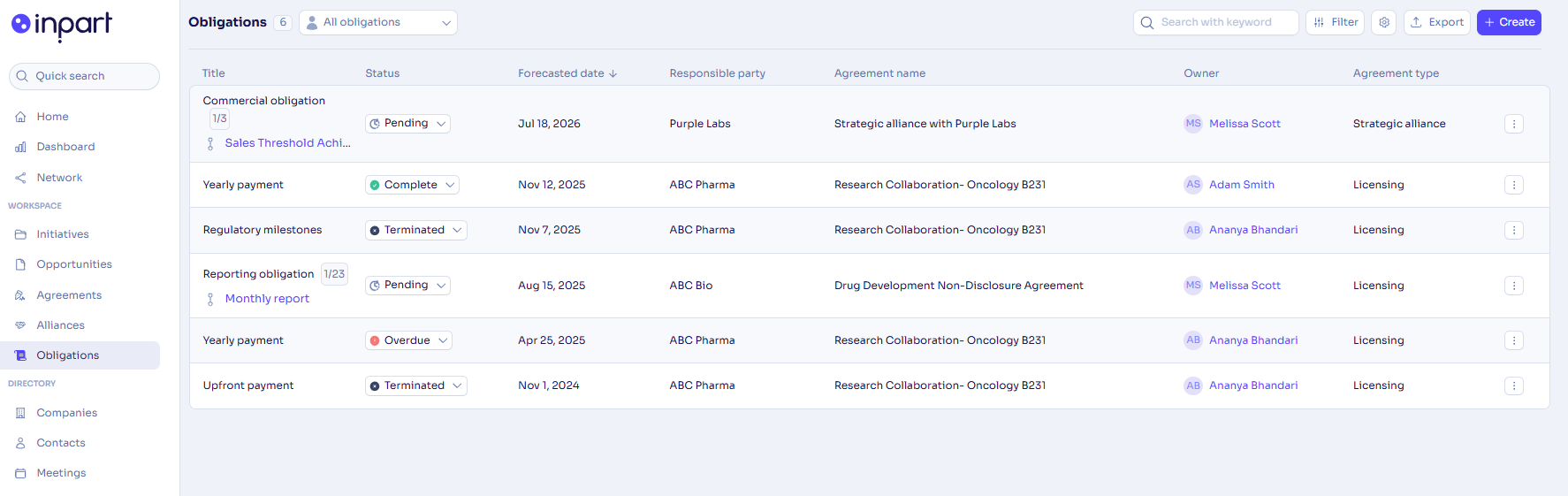
What's inside obligations
In each obligation, you can find the following information:
- Obligation name.
-
Obligation status:
- Pending: When the due date for the obligation is more than one month away.
- Upcoming: When the due date for the obligation is within the next month.
- Overdue: When the due date for the obligation has passed and the action required has not been completed.
- Completed: When the obligation has been fulfilled as required.
- Terminated: When the obligation is ended before it was fulfilled.
- In Dispute: When the obligation is on hold due to a disagreement between the parties involved.
- Due date: Lists the due date for each obligation, allowing you to keep track of upcoming deadlines.
- Responsibility: Displays Internal if your company is responsible, displays the name of the partner company if they're responsible, or Joint if both parties are responsible.
- Owner: Displays the name of the user who created the obligation.
- Obligation details: Agreement name, Obligation type, Obligation ID, Description, Territories...
- Notes.
- Attachments.
- Additionally, if the obligation is financial, a Financial information section is displayed; if it is a royalty obligation, a Royalty details section is displayed.
Manage obligation categories and types
Required user role: Manager with Business Admin role.
By default, we offer three categories of obligations, each supporting a range of obligation types.
- Obligation categories are provided by default by the application and can't be modified.
- Some standard obligation types are provided by default by the application, but as a Business Admin, you can add more types and edit or remove existing ones.
| Obligation categories | Default obligation types |
| Financial obligations | Recurring payment, Milestone payment, Upfront payments |
| Non-financial obligations | Meeting, Report, Other |
| Royalties | Royalties |
Navigate to the Agreement tab of the Administration page and select Obligation type in the Obligations section. From here, you can see the list of default obligation types (marked by the Inpart icon).
Add new obligation types
Click Add, a pop-up will open. Select the obligation category under which you want to create the new obligation type and enter a name for it.
Edit or remove existing obligation types
Click the more option button next to the obligation type you want to modify, and select Edit or Remove and Delete.
Create obligations
Open the obligations hub and click Create.
Or open the desired agreement page, go to the Legal terms tab, All obligations sub-tab, and click Create Obligation.
A pop-up will open. If you're in the obligation hub, select the agreement in the drop-down list. Then select the relevant document. You can skip this step if you prefer to create an obligation without a document; in this case, you can only create the obligation manually.
From there, you can choose to create the obligation(s) manually or extract it automatically using AI.
Please reach out to your Customer Success Manager at Inpart to request the activation of the AI obligation extraction feature. This AI feature is still in beta, and we're working hard to improve it. If something doesn't work as expected, let us know!
Manual creation
If you select a document, this document will open on the left side of the page, with a set of fields to fill in on the right side of the page.
Autofill fields
You can autofill the starred fields by simply highlighting relevant text in the agreement PDF on the left, making it faster and easier to create your obligation.
Add milestones
Obligations can be linked to milestones and triggered by the milestone’s completion, rather than being tied to a fixed calendar forecasted date.
Make obligations recurring
Toggle the Recurring Pattern button and select the recurrence.
Select currencies
During the obligation creation, when you set an estimated or final amount for an obligation (payment or royalty), enter the amount and select a currency from the dropdown. Each amount is then displayed in the format specific to its currency.
To enable more currency options, please contact your Customer Success Manager at Inpart.
AI extraction
Please reach out to your Customer Success Manager at Inpart to request the activation of the AI obligation extraction feature. This AI feature is still in beta, and we're working hard to improve it. If something doesn't work as expected, let us know!
In the obligation creation pop-up, click Extract obligations. The loading screen below will appear. You can stop the extraction at any moment by clicking Stop extraction at the bottom of the page.
Once the extraction is done, the list of suggested obligations is displayed for review, with a mention of the obligation type.
Open the cards one by one to validate, add, or edit the information.
Some fields require to be validated manually, click the round check icon next to them to do so.
Once done and all the information extracted is valid, click Create at the bottom of the page. Click Discard if you don't want to create this suggested obligation.
You can also discard all suggested obligations at once. Click Discard all. After that, click Select another document to start a new creation flow with another document, or click Create manually to start adding obligatobligationsly from the existing document still displayed on the left side of the screen.
Click Save and Close to leave the obligation process and come back to it later.
In this case, a message is displayed in the Legal terms tab of the agreement to prompt you to review the ongoing obligation drafts. You can't start a new obligation extraction before you've finished reviewing the ongoing one.
Filter obligations by amount
You can filter obligations in US dollars (USD) by their amount, for example, to show all obligations above a given value. Other currencies will come in later versions.
Export obligation amounts
Obligation amounts are included when you export data to Excel or Power BI, with the amount and its currency both represented.
Set email notifications
You can set a reminder date at the bottom of this form to receive an email notification.
To complete the creation process, click:
- Save and create new to create the current obligation and open a new blank form with default values.
- Save and duplicate to create the current obligation and open a new form with all values unchanged to create a duplicate.
- Save and close to simply save the current obligation and go back to the agreement page.
Estimated amount vs Actual amount
You can record the estimated amount vs the actual amount to retain the obligation's financial information history.
When the obligation is Pending, Upcoming, Overdue or In dispute (default statuses names), the Estimated amount field is editable, and the Actual amount is empty and non-editable.
When the obligation is Complete (default status name), the Actual amount is editable, and the Estimated amount is no longer editable.When the obligation is Terminated (default status name), the Estimated amount is no longer editable, and the Actual amount is empty and non-editable.
Attach documents
Add context and clarity to your obligations by attaching relevant documents, like invoices, reports, or any supporting files.
First, you need to create the obligation. Once the obligation is created, open it. The Attachments section is available at the bottom of the obligation page. Click Add or drag and drop your files. You can add files or links.
Filter obligations
Existing filter panel
In the obligation hub or the related agreements, you can use the search bar to find obligations by their name.
In the agreement page, you can also apply the quick filters available at the top of the obligation list to reach the information you're interested in with a single click. You can filter obligations by their type and status.
For advanced filtering, click the More filters button to open a filtering panel on the right side of the page. From here, you can filter obligations based on all the fields that they contain. Click Apply filters at the bottom of the panel to apply your filtering preferences.
[Beta] New filter panel
This new filter panel is available for beta users only. Please contact your CSM at Inpart if you wish to enable the beta mode on your Deal platform and try this new feature.
On the obligation hub page, click the Filter button.
On the obligation list of agreement and alliance pages, click the More filters button.
A filter panel will open on the right side of your screen. Use the search bar to quickly find the relevant criteria. Select the relevant values and click Apply filters. To clear all filters, click Clear all.
Export obligations
You can export obligations from the obligation hub to a standard Excel file.
Two parameters need to be taken into account to generate a finely targeted export:
- Which obligations do you want to export? To define the perimeter of the obligations you want to export, apply filters first before proceeding to the export. You can export all the obligations or only the ones that match the filters.
- Which fields do you want to export? To define the perimeter of the fields displayed in the export, add or remove columns in the list of obligations before proceeding to the export. One column corresponds to one field.
To proceed to the export, click Export at the top of the obligations hub. A pop-up will open. From there, you can either choose to:
- Export all available columns (i.e., obligation fields) even if they're hidden in the list of obligations.
- Export only the columns (i.e., obligation fields) chosen for display on the list of obligations for a light and finely targeted export.
Then, click Confirm. An Excel export will instantly be downloaded.
Edit or delete obligations
Click the more options button and select Edit or Delete.
Manage obligation notifications
You can manage your email notifications related to obligation activities on your account page. Open the navigation bar, click your avatar at the bottom, select Account, and open the Notifications tab.